K12 communication strategy

A Culture of Communication

The trust account in K12 education

Chris Sadler  ·  Founder, Board to Desk

Every school and district already has a culture of communication. This is the guide to understanding it, shaping it, and making it work for everyone inside it.

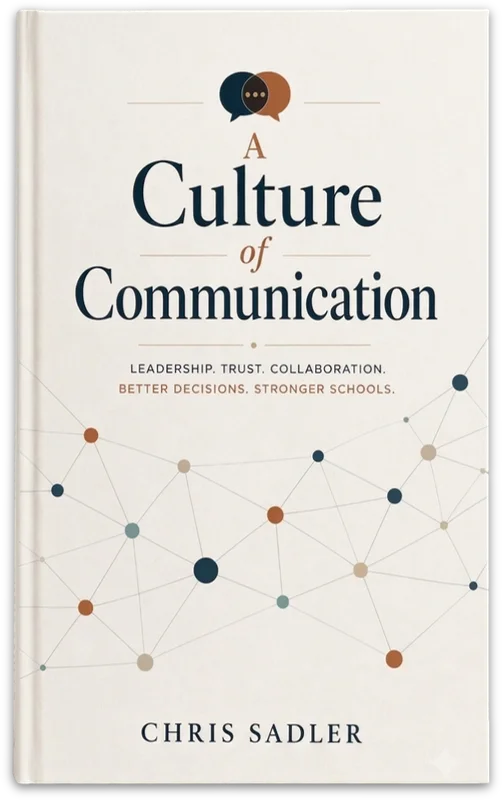
A Culture of Communication book cover

For everyone in a school or district

Four roles. One culture. One book.

This book is written for everyone who participates in the communication culture of a school or district. That is everyone who teaches, leads a building, serves the district, or makes decisions from the central office. All four are inside the same culture. All four shape it through every ordinary act.

Teacher
Your everyday exchanges are the culture in motion
Principal
You convene and set the tone for the whole building
District Staff
You often determine who the culture reaches
District Leader
Your communication sets conditions for the whole district

Your everyday acts, planned and informal, are the culture in motion.

The concept

The trust account

Every act of communication in a school or district either builds or depletes the community's trust. Trust accumulates through pattern, across every interaction, over time. The balance on any given day is the culture's record. Interact with any scenario below to see it in motion.

Trust account balance
Deposits
+620
accumulated through ordinary acts
DepletedFull
+80Starting balance, a culture already in motion
Deposits
A teacher sends a clear, personal update about what students learned this week
+95
A principal is transparent about a difficult budget decision, before the rumor starts
+140
The front-office staff greets every parent by name, every morning
+60
A district leader responds to a community concern within 24 hours with real information
+110
Withdrawals
Parents learn about a policy change from a community Facebook group before the school announces it
175
A school newsletter contradicts what a principal said in person last week
130
An automated message goes out with an error, uncorrected for three days
90

Every chapter in the book builds on the trust account, giving you the framework to understand what's happening in your culture and why. Nine principles. One guide.

The architecture

The chapter journey

Nine chapters in sequence, each principle building on the one before. Expand any phase to explore the chapters within it.

Foundation
·
Intro + Ch 1–3

The book opens by naming the culture that already exists and showing what it does to trust. These chapters establish the two foundational ideas everything else builds on: the culture is already happening, every act shapes the trust account, and internal honesty is what external credibility grows from.

Introduction
A Culture of Communication
Orients the reader inside the culture they already inhabit. Names it. Introduces the trust account as the navigating instrument and grounds both in research.
Read more
Chapter 1
The Culture Is Already Happening
Every act of communication, planned or unplanned, formal or informal, is the culture itself, assembled in real time by everyone who participates.
Read more
Chapter 2
Every Act Is a Deposit or a Withdrawal
Every act of communication builds or depletes the community’s trust. The trust account accumulates through pattern over time.
Read more
Chapter 3
Internal Communication Is the Foundation
What people genuinely know and understand internally determines the honesty of what they can say to the community.
Read more
Exposure
·
Ch 4
High-stakes moments don’t create the trust account. They expose it. This chapter turns from the ordinary texture of the culture to the moments when everything accumulated becomes visible and consequential.
Reach
·
Ch 5–6
Communication doesn’t stay where it was sent. These chapters trace how the culture reaches people through social networks, through reshaping in transit, and through the question of who it reaches at all.
Meaning
·
Ch 7–8
Communities don’t receive communication passively. They assemble their own meaning from it. These chapters address what governs which version of events travels, and what holds the culture’s signal together.
Destination
·
Ch 9
The book’s destination. When the culture is working at full strength, trust is the ambient condition, and what becomes possible inside it cannot be manufactured by any communication tactic alone.

Your lens

Every role has a position in the culture

This book is written for everyone in a school or district. Select your role to see which chapters speak most directly to where you stand.

As a teacher, every email home, every hallway conversation, every note in the agenda is the culture of communication. This book names what you’re already doing, and shows why it matters to the whole.
Introduction
A Culture of Communication
Key chapter
Chapter 1
The Culture Is Already Happening
Your daily acts, planned and unplanned, are the culture in motion.
Key chapter
Chapter 2
Every Act Is a Deposit or a Withdrawal
Every message you send is a deposit or a withdrawal in the trust account.
Chapter 3
Internal Communication Is the Foundation
Chapter 4
The Account Balance You Earn Is the One You Have
Key chapter
Chapter 5
Communication Travels Further Than It Was Sent
Your communication reaches families your school’s official channels never touch.
Chapter 6
The Culture Reaches Everyone
Key chapter
Chapter 7
The Community Tells Its Own Story
The community’s version of your classroom is assembled from every fragment it receives.
Chapter 8
Coherence Is the Culture's Protection
Chapter 9
What the Culture Makes Possible

Chapters 5 & 7

Communication travels further than it was sent

Choose who sends the message. Watch it travel through the real network of relationships in a school or district, through staff, through community connectors, out to families, students, and beyond. Then see what the community assembles and sends back.

Click “Send with trust” to begin
Internal staff
Community connector
Families
Students
Community
Story coming back

A practical guide to building a stronger culture of communication

Sign up for the Board to Desk newsletter to receive updates on the release of A Culture of Communication, including new chapter previews as they become available.

You will receive the Board to Desk newsletter, including updates about the book and new chapter releases. Unsubscribe at any time.

About the author
Chris Sadler
Chris Sadler
Founder of Board to Desk and a practitioner in K12 communication strategy. A Culture of Communication is the first guide to communication strategy written from inside the work, for everyone in a school or district. It draws on CCO Theory, Collective Efficacy research, and two decades of work alongside educators.